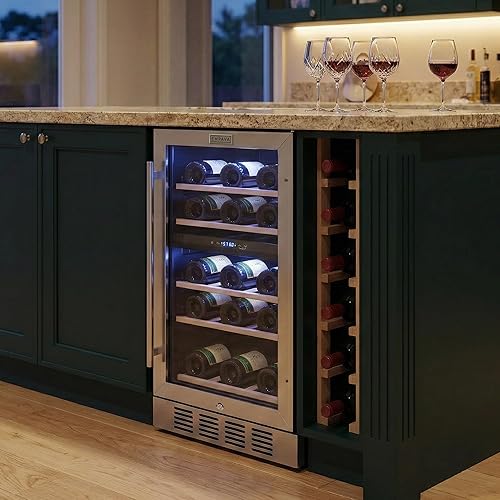
A built-in wine cellar does two things a freestanding unit cannot: it slides flush with your cabinetry for a clean look, and it vents through the front so heat never builds up against the wall behind it. That front-venting design is the single most important spec to confirm before you buy, because installing a rear-vent cooler in a tight cabinet opening will shorten its life fast. Beyond that, the market for true built-in wine cellars is smaller and more specialized than the broader wine cooler category, so it pays to read carefully before committing. We screened every model for a rating of at least 3.8 stars, a compressor cooling system, and genuine built-in or undercounter installation support. The three models that cleared every bar are ranked below, with notes on the models that did not make the cut and why.
Short answer: The NewAir NWC046BS00 (around $632, ASIN B07V1VN19X) is the strongest all-around pick with 71 verified ratings at 4.0 stars and 46-bottle capacity in a true built-in form factor. If you want a narrower 15-inch fit under a counter, the Empava dual-zone model (around $798, ASIN B0GMWVTS53) scores an impressive 4.9 stars across 15 reviews. The KoolMore KM-CW28DZ-WPR (around $1,265, ASIN B0DCV3K9FQ) is a premium matte-black option rated 4.6 stars, though its 23-bottle capacity is modest for the price.
The NewAir NWC046BS00 is the most review-backed built-in wine cellar in this category, with 71 ratings averaging 4.0 stars and a 46-bottle capacity that beats every other qualifying model. At around $632, it delivers a compressor cooling system, a reversible door, and a black stainless steel finish in a cabinet-ready 22.5 by 23.5 by 33-inch frame.
Best for: Buyers who want the most storage capacity and the most real-world rating data at a mid-range price
Pros
Largest bottle capacity of any qualifying built-in model at 46 bottles
Most verified reviews in the category at 71 ratings averaging 4.0 stars
Compressor cooling holds temperature even in warm kitchens
Reversible door swing adapts to left- or right-side cabinet openings
Priced under $650, making it the best value per bottle of storage
Cons
Single zone only, so you cannot hold separate temperatures for reds and whites at the same time
Black stainless steel finish may not match stainless appliances in some kitchens
Bottom line: The NewAir NWC046BS00 is the safest first pick in this category. More reviews, more bottles, and a price that leaves room for a solid wine collection to fill it.
The Empava 15-inch dual-zone wine cooler earns the highest user rating of the group at 4.9 stars across 15 reviews. Its narrow 15-inch width fits undercounter openings where a full 24-inch unit will not, and the dual-zone compressor system lets you store reds and whites at the same time in its 26-bottle interior.
Best for: Anyone who wants to store reds and whites simultaneously in a narrow cabinet opening or bar cutout
Pros
Highest rating of any qualifying model at 4.9 stars
Dual-zone temperature control for simultaneous red and white storage
15-inch width fits tight undercounter or bar cutouts
Frost-free compressor with reversible glass door
Lightweight at 71.5 lb, easier to maneuver during installation
Cons
Only 26-bottle capacity, limiting it to a curated bar selection rather than a large collection
Fewer reviews than the NewAir, so the 4.9-star average has less statistical weight
Bottom line: If dual-zone capability is the priority, the Empava delivers it in a narrow footprint at a fair price, with a user rating that suggests early buyers are satisfied.
The KoolMore KM-CW28DZ-WPR brings a flat matte-black finish and a compressor cooling system to a narrow 14.8-inch column footprint. Its 4.6-star rating across 3 reviews suggests early owners are happy, though the 23-bottle capacity feels modest against its $1,265 price tag.
Best for: Design-focused buyers who prioritize a premium matte finish and can live with a smaller bottle count
Pros
Rated 4.6 stars, second highest of the qualifying models
Premium matte-black finish suits modern and transitional kitchen designs
Compressor cooling with automatic defrost for reliable year-round performance
Reversible door and narrow 14.8-inch width for tight installations
Lightweight at 75 lb for a compressor-based unit
Cons
Only 23-bottle capacity for a $1,265 price, the worst value-per-bottle ratio in the group
Only 3 reviews, so the 4.6-star rating is based on very limited data
Bottom line: The KoolMore looks great and is well-built by early accounts, but the capacity-to-price ratio lags behind the NewAir by a wide margin. Buy it for the aesthetic, not the storage math.
ROVSUN dual-door model: 3.4-star rating across 5 reviews with no recent purchase data. Falls below the 3.8-star minimum threshold and has insufficient reviews to evaluate reliably.
Buying guide
Built-In vs. Freestanding: Why the Distinction Matters
The terms built-in and freestanding get used loosely by retailers, and that looseness can cost you a ruined compressor. A true built-in wine cellar pulls room-temperature air through vents at the front of the unit and exhausts warm air out the same way, so the cabinet enclosure around it does not trap heat. A freestanding cooler vents from the back or sides and needs several inches of clearance on all sides to breathe. Putting a freestanding model in a tight cabinet opening causes the compressor to run hot, cycle more often, and eventually fail early. Before you buy, find the installation spec sheet and look for the words front-venting, undercounter, or built-in rated. If the spec sheet only says freestanding, walk away. The models we ranked here are all designed for flush installation, which is the baseline requirement for this category.
Single Zone vs. Dual Zone Temperature Control
A single-zone cooler holds one temperature throughout the entire cabinet, which works well if you collect primarily one style of wine, such as reds or whites. A dual-zone unit splits the interior into two separate temperature regions, typically one warmer section for reds and one cooler section for whites, controlled independently. Reds generally store best between 55 and 65 degrees Fahrenheit, while whites and sparkling wines prefer 45 to 55 degrees. If your collection mixes both styles and you plan to store bottles for more than a few weeks, a dual-zone model is worth the extra cost. The Empava 15-inch model in our rankings is the only dual-zone option among the qualifying picks and it carries the highest user rating of the group at 4.9 stars.
Bottle Capacity: What the Numbers Actually Mean
Manufacturers measure bottle capacity using standard 750 ml Bordeaux-style bottles, which are narrower than Burgundy or Champagne bottles. If you collect Burgundy pinots or sparkling wines, your real-world capacity will be lower than the spec sheet number. The NewAir NWC046BS00 lists 46-bottle capacity, which is the largest of the qualifying models and one of the reasons it ranks first for most buyers. The Empava holds 26 bottles and the KoolMore holds 23. Neither of those numbers is wrong, but they do reflect units designed more for a curated bar selection than a serious collecting cellar. If you want to age 40 or more bottles at a time, the NewAir is the only built-in model in this lineup that comes close to meeting that need.
Dimensions and Cabinet Fit: Measure Twice
Standard undercounter openings in American kitchens are typically 24 inches wide and 34 inches tall, which aligns with full-size dishwasher dimensions. The NewAir NWC046BS00 at 22.5 by 23.5 by 33 inches fits that opening with room for a finished toe-kick and a door gasket. The KoolMore at 22.6 by 14.8 by 33.9 inches is a narrow column unit that works well in a bar cutout or alongside a refrigerator column. The Empava at 22.36 by 14.96 by 32.28 inches is also a 15-inch-wide unit suited for the same tight spaces. Always add at least a quarter inch to each dimension for installation clearance before you order, and confirm the rough opening with a tape measure rather than trusting the existing cabinet frame to be square.
What to Expect at Each Price Point
Under $700 you can get a solid compressor-based built-in with 40-plus bottle capacity, as the NewAir demonstrates at around $632. From $700 to $900 you move into dual-zone territory with the Empava at $798, adding the flexibility to store reds and whites at the same time. Above $1,000 the KoolMore at $1,265 adds a premium matte-black finish and sturdy compressor but delivers fewer bottles than the NewAir at nearly half the price. In this category, spending more does not always mean more capacity. The value sweet spot for most buyers is the $600 to $800 range, where you get a compressor cooler, a reversible door, and enough bottles for a functional home bar setup.
Door Orientation and Finish
All three qualifying models offer reversible door swing, which matters when your cabinet opening is flanked by a wall or another appliance on one side. Confirm which side the hinge ships on and whether the reversal is a simple screw move or requires a service call. For finish, the NewAir comes in black stainless steel with a stainless trim, the KoolMore in a flat matte black, and the Empava in silver with a glass door. Glass doors look sharp but admit light, and sustained UV exposure degrades wine slowly over time. If the unit sits under a counter away from direct sunlight, a glass door is fine. If it faces a sun-facing window, opt for a solid door or use a UV-blocking film.
Common mistakes to avoid
Installing a rear-venting freestanding cooler in a cabinet cutout and wondering why the compressor fails inside two years.
Buying on bottle count alone without checking whether the stated capacity is measured with Bordeaux bottles, then discovering half the collection is Burgundy-shaped and does not fit the shelves.
Skipping the rough-opening measurement and ordering a unit that is a quarter inch too wide for the existing cabinet frame.
Choosing thermoelectric cooling to save money, then finding the unit cannot hold temperature in a kitchen that gets above 75 degrees Fahrenheit in summer.
Placing the cooler on a slanted or unlevel floor without shimming it first, which causes the compressor to wear unevenly and makes the door gasket seal poorly.
Ignoring the warranty terms: some brands offer a one-year parts warranty that does not cover the compressor separately, leaving you exposed to the most expensive repair.
Frequently asked questions
What is the difference between a built-in and a freestanding wine cooler?
A built-in wine cooler vents through the front panel so it can sit flush inside a cabinet without overheating. A freestanding unit vents from the rear or sides and needs open air around it. Installing a freestanding cooler in a cabinet enclosure restricts airflow, causes the compressor to overheat, and shortens the unit's life. Always check the product spec sheet for the words front-venting or built-in rated before purchasing a unit you intend to install in cabinetry.
How cold should a built-in wine cellar get?
Most wine storage guidelines recommend 55 degrees Fahrenheit as the ideal long-term aging temperature for red wine, and 45 to 50 degrees for whites and sparkling. The compressor-based models in our rankings can typically reach temperatures as low as 40 to 45 degrees Fahrenheit, which covers both zones comfortably. Set the temperature and give the unit 24 hours to stabilize before loading bottles, since the thermal mass of the wine itself will shift the internal temperature slightly once the unit is loaded.
Can I install a built-in wine cooler under a kitchen counter?
Yes, undercounter installation is exactly what built-in wine cellars are designed for. The key is that the opening must match the unit's dimensions with at least a quarter inch of clearance on each side, and the floor of the cabinet must be level. Most undercounter units also require that the door can open a full 90 degrees without hitting an adjacent cabinet or appliance, so measure the swing arc as well as the opening itself. If the existing countertop height is non-standard, check whether the unit's height is adjustable via leveling feet.
Is a compressor wine cooler better than a thermoelectric one?
For built-in installations, compressor cooling is almost always the better choice. Thermoelectric coolers are quiet and vibration-free, but they can only cool to about 20 degrees below the ambient room temperature. In a kitchen or bar area that reaches 78 to 80 degrees in summer, a thermoelectric unit may not be able to hold a target of 55 degrees without struggling. Compressor coolers can maintain their set temperature regardless of the room temperature, making them more reliable year-round. The tradeoff is minor vibration, which is worth accepting for the temperature stability.
How many bottles does a typical built-in wine cellar hold?
The qualifying models in this guide range from 23 bottles (KoolMore, ASIN B0DCV3K9FQ) to 46 bottles (NewAir, ASIN B07V1VN19X). These numbers are based on standard Bordeaux-shaped 750 ml bottles. Wider Burgundy or Champagne bottles will reduce actual capacity by roughly 15 to 20 percent. If your collection is mixed, estimate realistically before you buy. For a dedicated home bar with a rotating stock of 20 to 30 bottles, any of the three models works. For a collecting cellar with 40-plus bottles, the NewAir is the only option in this lineup that comes close.
Do built-in wine cellars need a dedicated electrical circuit?
Most residential built-in wine coolers run on a standard 110 to 120-volt outlet and do not require a dedicated circuit, though local building codes vary. The models ranked here specify either 110, 115, or 120 volts and standard plug connections. However, if you are installing the unit in a newly built kitchen or bar area, it is good practice to run a dedicated 15-amp circuit to the location to avoid sharing a breaker with a refrigerator or dishwasher. Ask a licensed electrician to confirm the circuit load before installation if you are combining multiple appliances on one run.
What should I look for in a wine cellar door?
The door seal and glass type are the two most important door features. A tight-fitting magnetic gasket keeps temperature swings to a minimum every time you open and close the door. If the unit has a glass door, UV-resistant tempered glass is preferable to standard glass because sustained UV exposure breaks down wine's flavor compounds over months and years. All three qualifying models use a single door design, and the Empava (ASIN B0GMWVTS53) uses a glass panel that is marketed as UV-blocking. Reversible hinges are a practical bonus that all three units share, making installation easier in tight or flanked spaces.
Final recommendation
The built-in wine cellar category is narrower than most shoppers expect, and the gap between a true built-in and a freestanding unit marketed as built-in can cost you a compressor. Of the models we reviewed, the NewAir NWC046BS00 (B07V1VN19X) offers the best combination of verified reviews, bottle capacity, and price for most buyers. The Empava dual-zone unit (B0GMWVTS53) is the pick for anyone who stores both reds and whites. For a premium matte-black finish in a narrow column footprint, the KoolMore (B0DCV3K9FQ) delivers, though its capacity does not justify the price premium for most shoppers. Questions about any of these models? Email us at [email protected].
We use necessary cookies to keep the site working. With your permission, we also use functional, analytics, and marketing cookies. Read our Cookie Policy.