How to Choose a Built-In Wine Cellar
Choose a built-in wine cellar by matching bottle capacity to your collection size, picking a compressor unit for long-term aging, deciding between single and dual zones based on what you drink, and confirming the unit dimensions fit your cabinet cutout with front-venting clearance.

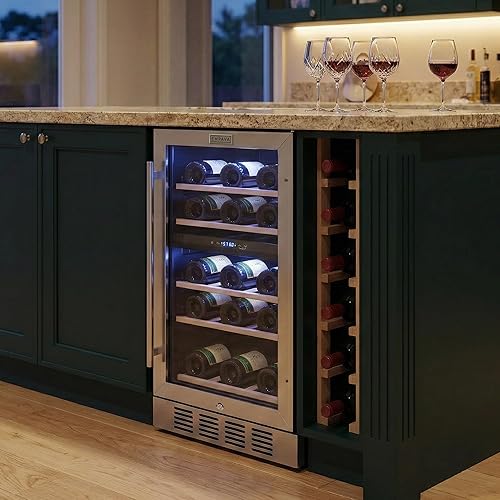

Built-In vs. Freestanding: Why It Matters
Built-in wine cellars are designed to vent heat through the front door grille rather than the sides or back, so they can sit flush inside a cabinet or under a counter without overheating. Freestanding units push heat out the sides and back and will overheat if enclosed, which shortens the compressor life and raises temperatures inside. If you plan to install a unit under a counter or between cabinets, confirm the product listing explicitly says "built-in" or "undercounter" installation. The Summit Appliance SWC3668, for example, lists both freestanding and undercounter installation options, which means it can work either way but requires more careful placement.
Capacity: Matching the Unit to Your Collection
Bottle capacity labels on wine cellars can be misleading because they assume standard Bordeaux-shaped 750 ml bottles stacked tightly. Pinot Noir and Burgundy bottles have wider shoulders and take up more shelf space, so a unit rated for 46 bottles may realistically hold 30 to 38 of those shapes. The NewAir NWC046BS00 is rated for 46 bottles across 5 shelves in a 5.3 cu ft cabinet, while the KoolMore KM-CW28DZ-WPR lists 23 bottles in a 6.5 cu ft body, a difference that reflects shelf layout as much as volume. Buy for your current collection plus about 25 percent to leave room for new purchases. If your collection runs past 50 bottles regularly, look for a dual-door or full-height undercounter unit rather than a compact.
Compressor vs. Thermoelectric Cooling
Compressor-cooled units work like a standard refrigerator: a refrigerant loop removes heat, and a fan circulates cold air. They can reach lower temperatures, handle warm ambient rooms, and maintain stable temps through seasonal changes. Thermoelectric units use the Peltier effect to move heat without a compressor, which means they run quieter and without vibration, but they can only cool about 20 degrees below the room temperature, making them unreliable in garages or unconditioned spaces. Every built-in unit in this category uses compressor cooling, including the NewAir NWC046BS00, Empava 15-inch dual zone, KoolMore KM-CW28DZ-WPR, and ROVSUN model. For a built-in installation that will age wine over months or years, compressor cooling is the right choice.
Single Zone vs. Dual Zone
A single-zone unit holds one temperature throughout the cabinet, which works well if you drink mostly one wine style, for example reds aged at 55 to 60 degrees Fahrenheit or whites chilled at 45 to 50 degrees. A dual-zone unit splits the cabinet into two independently controlled compartments, letting you store reds and whites at the same time without compromise. The Empava 15-inch dual zone runs at a rated 4.9 stars across 15 reviews and costs $798.39 for a 26-bottle unit, a premium worth paying if you regularly open both reds and whites at dinner. Most compact built-in units under $700 are single zone, so confirm the spec before buying if dual temperature is important to you.
Dimensions and Cabinet Fit
Standard undercounter built-in wine cellars are typically 15 or 24 inches wide and sized to fit a 34-inch cabinet height. The NewAir NWC046BS00 measures 22.5 by 23.5 by 33 inches and weighs 118 pounds, so plan for two people and a furniture dolly at installation. The KoolMore KM-CW28DZ-WPR is narrower at 22.6 by 14.8 by 33.9 inches and lighter at 75 pounds, fitting a 15-inch cabinet slot. Measure your cutout width, depth, and height, then subtract at least a half inch on each side for the door swing and leveling feet. Reversible door hinge is a useful feature when the cabinet placement dictates which side the door opens from, and both the NewAir and KoolMore units offer reversible hinges.
Finish and Long-Term Reliability
Stainless steel and black stainless finishes are the most common on built-in wine cellars and blend well with kitchen cabinetry. The NewAir NWC046BS00 uses a black stainless steel finish, the KoolMore KM-CW28DZ-WPR comes in matte black, and the Empava uses a glass-front panel in silver. Glass-front doors let you see the collection at a glance but require UV-filtering glass to prevent light damage to wine over long storage. Look for units with automatic defrost, which all the compressor units in this category include, to avoid manual frost removal and the temperature swings that come with it. With only a handful of reviews available across most built-in wine cellar models, checking for a manufacturer warranty of at least one year on parts and labor is especially important before purchasing.
Common mistakes to avoid
- Buying a freestanding unit and installing it in a cabinet: side and rear ventilation is blocked, the compressor overheats, and temperatures inside the cabinet rise above safe wine storage range.
- Trusting the bottle capacity number without accounting for bottle shape: Burgundy and Champagne bottles are wider than the Bordeaux bottles most capacity ratings assume, so real-world capacity can run 20 to 30 percent lower.
- Skipping the dimension check: a unit that is even one inch too wide or too tall will not slide into a cabinet cutout, and returning a 118-pound appliance is a major hassle.
- Choosing thermoelectric cooling for a garage or unconditioned space: thermoelectric can only cool roughly 20 degrees below ambient, so a 90-degree garage means a 70-degree minimum inside, far too warm for wine.
- Ignoring the door swing direction before ordering: if the door hinge is on the wrong side for your layout, the door will block a drawer or wall; check whether the unit has a reversible hinge.
- Buying a single-zone unit when you regularly drink both reds and whites: serving a Cabernet at 45 degrees ruins the wine just as surely as serving a Chardonnay at 60 degrees.
Frequently asked questions
What temperature should a built-in wine cellar be set to?
For long-term aging, 55 degrees Fahrenheit is the classic target and works for most reds. Whites served at the table are typically chilled to 45 to 50 degrees. Dual-zone units let you run both temperatures simultaneously in the same cabinet.
Can I use a built-in wine cellar as a freestanding unit?
Most built-in units vent heat through the front grille and can technically stand alone, but verify in the product specs. Some models, like the Summit Appliance SWC3668, explicitly list both freestanding and undercounter installation. Units listed as built-in only may have cosmetic side panels that look unfinished when exposed.
How much clearance does a built-in wine cellar need?
Front-venting built-in units typically need 1 to 2 inches of clearance in front of the grille to allow airflow. Check the manufacturer spec sheet for your specific model. Blocking front ventilation is the most common cause of overheating and compressor failure in undercounter installations.
Is a compressor wine cellar too loud for a kitchen or dining area?
Compressor units produce a low hum similar to a standard refrigerator, typically in the 35 to 45 decibel range. In an open kitchen or near a dining table this is audible but not disruptive. If noise is a major concern, look for models that advertise low-noise compressors or check user reviews specifically for noise comments.
How many bottles do I actually need to store?
A good starting point is your current bottle count plus 25 percent for growth. If you open two to three bottles a week and replenish regularly, a 24 to 36 bottle unit usually covers everyday drinking with room to age a dozen bottles longer term. Serious collectors who buy by the case should look at units rated for 46 bottles or more.