Built-In vs Freestanding Wine Cellar: Which Type Is Right for You
Choose a built-in wine cellar when you want the unit flush inside cabinetry or under a counter. Choose a freestanding unit when you have open floor or counter space and want a lower price. The single biggest difference is ventilation: built-in models push heat out the front, freestanding models push it out the sides and back and need several inches of clearance on every exposed surface.

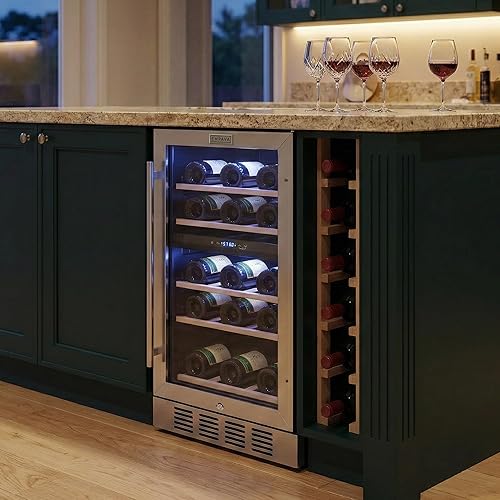

How Ventilation Decides Everything
A built-in wine cellar is engineered to exhaust heat through a front grille, so the sides and back can press against cabinet walls without any airflow penalty. Freestanding units route heat through rear or side vents, which means blocking those surfaces traps heat inside the compressor compartment and shortens the unit's life. Manufacturers typically require two to four inches of clearance on the sides and four to six inches at the rear for freestanding models. If you measure your opening and find those clearances impossible, a freestanding unit is not a safe fit regardless of price.
Cost and Installation Differences
Freestanding wine coolers generally cost less at the same bottle capacity because the front-vent engineering adds to the build cost of built-in models. Among the units in this category, built-in compressor models like the NewAir NWC046BS00 at $631.95 and the Empava 15-inch dual-zone at $798.39 reflect that premium. Installation for a built-in unit usually means a carpenter trim-out or a factory-built cabinet opening sized to the unit's dimensions, while a freestanding cooler can simply be rolled into position. Plan for a licensed electrician if you are adding a dedicated circuit to a new cabinet opening.
Capacity and Sizing in Practice
Built-in undercounter wine cellars are almost always compact by necessity, since standard base cabinet height limits depth and height. The NewAir NWC046BS00 holds 46 bottles in a 5.3 cubic foot cabinet that is 22.5 inches wide and 33 inches tall, which fits neatly under a 36-inch counter. The Empava 15-inch dual-zone fits a tighter 14.96-inch-wide opening and holds 26 bottles at 32.28 inches tall. Freestanding units face no such height or depth constraints and can scale up to large floor-standing columns, which is worth considering if your collection runs past 50 to 100 bottles.
Cooling Method: Compressor vs Thermoelectric
Most built-in wine cellars in this category use compressor cooling, including the NewAir, Empava, KoolMore, and ROVSUN models listed here. Compressor coolers reach lower minimum temperatures, handle warm room ambient better, and recover faster after you open the door. Thermoelectric coolers produce no vibration and run silently but struggle when the room is more than 65 to 70 degrees Fahrenheit warmer than your target cellar temp. If your installation space gets warm in summer, a compressor-based built-in is the safer choice. Thermoelectric models work best in climate-controlled rooms where ambient temperature is stable.
Single Zone vs Dual Zone
A single-zone built-in holds the entire cabinet at one temperature, which works well if you drink primarily one style, such as all reds or all whites. Dual-zone models, like the Empava 15-inch, maintain two independent temperature chambers so you can store reds at 55 to 65 degrees and whites or sparkling at 45 to 50 degrees in the same footprint. Dual-zone units typically cost more and use more energy, but they remove the need to own two separate coolers. If your collection mixes red and white wine regularly, the flexibility is usually worth the added cost.
Which Type Adds More to Your Kitchen Aesthetics
Built-in units are designed to present a furniture-grade look: they sit flush with surrounding cabinetry, and most feature stainless steel or glass-door fronts with matching handles. The KoolMore KM-CW28DZ-WPR, for example, uses a matte black finish at 22.6 inches wide that presents cleanly under a dark kitchen island. Freestanding units often have utilitarian side panels since those surfaces are visible only when the unit is in an open area. If the cooler will be seen as part of the kitchen design rather than tucked away, built-in finishing details tend to hold up better visually.
Common mistakes to avoid
- Buying a freestanding wine cooler and then placing it inside a cabinet or under a counter, which blocks side and rear vents and causes the compressor to overheat.
- Measuring only the width of a cabinet opening and forgetting to check height and depth, then finding the unit does not fit once it arrives.
- Choosing thermoelectric cooling for a built-in in a garage or unconditioned space where summer ambient temperatures spike above 80 degrees Fahrenheit.
- Assuming any wine cooler labeled 'built-in capable' is the same as a true built-in. Check that the spec sheet explicitly says 'front venting' before purchasing.
- Ignoring the reversible door option when buying a built-in unit. Once the unit is trimmed in, reversing the hinge direction is difficult or impossible without removing the unit entirely.
- Skipping a dedicated circuit. Most built-in compressor wine cellars draw enough current that sharing a circuit with other appliances can trip the breaker repeatedly.
Frequently asked questions
Can I use a freestanding wine cooler as a built-in?
Only if the manufacturer explicitly rates it for built-in use and confirms front venting. Most freestanding wine coolers vent from the rear or sides, and boxing them in without adequate clearance will overheat the compressor and void the warranty.
What clearance does a built-in wine cellar need?
A true built-in with front venting needs no side or rear clearance once trimmed into its opening. You do need the cabinet opening to match the unit's listed width, depth, and height within about a quarter inch on each side, plus a small gap at the top for the door to open fully.
Is a compressor or thermoelectric wine cooler better for a built-in installation?
Compressor models are better for most built-in installations. They cool more aggressively, handle warm ambient air more reliably, and are not limited by the temperature differential between the room and the target cellar setting. Thermoelectric coolers work in stable, cool environments but are a poor fit for enclosed cabinet spaces that heat up.
How many bottles can a standard undercounter built-in wine cellar hold?
Most 15-inch-wide undercounter built-ins hold 20 to 30 bottles. A 24-inch-wide unit, such as the NewAir NWC046BS00, can reach 46 bottles at 5.3 cubic feet. Bottle counts in specs assume standard 750 ml Bordeaux-style bottles, so larger Burgundy or Champagne bottles will reduce the usable count.
Who should I contact if I have questions about built-in wine cellar recommendations?
You can reach the FridgeFanatic team at [email protected]. We are happy to help match a specific unit to your cabinet dimensions and collection size.